Food isn’t just a necessity; it’s a world of hidden science and peculiar mysteries. Some natural phenomena in common foods are so bizarre that they seem almost magical. From nuts to fruits, every bite offers more than just flavor; it reveals an intricate world of processes that shape how we experience our food. Here are 10 of the most mind-blowing natural phenomena you didn’t know were happening in the foods you eat every day.
Cranberries
Imagine a fruit bouncing like a rubber ball. That’s what happens when you drop a ripe cranberry on the ground. The firmness and the air pockets inside the fruit allow it to bounce, much like a bouncy ball. This curious trait is used by cranberry farmers to test for ripeness. When cranberries are dropped, those that bounce are considered ripe, while those that don’t are left to be used for juices. This unusual trait was first discovered in the 1880s by a New Jersey farmer who accidentally dropped his cranberries down a staircase!
Brazil Nut
Have you ever noticed that Brazil nuts always rise to the top of a container, leaving the smaller nuts at the bottom? Known as the “Brazil Nut Effect,” this strange occurrence has baffled scientists for years. The effect happens due to a process called granular convection, which happens when similar objects, like nuts, are jostled together. As larger pieces move upward, smaller pieces fall to the bottom. Yet, the Brazil nuts stay on top, defying all expectations. This phenomenon isn’t limited to snack containers; it also applies to other granular materials, such as sand and gravel, and even rivers, where larger rocks settle on the surface.
Corn

Have you ever looked at an ear of corn and wondered why it always has an even number of rows? This fascinating phenomenon occurs because corn is not just a vegetable; it’s an inflorescence, a plant that produces numerous flowers. Each ear of corn can have as many as 800 kernels, typically arranged in 16 rows. This pattern of even rows occurs because each kernel’s development starts with a cell division that always results in two cells, and continues dividing into two more cells, ensuring an even number. Corn is not alone in this; fruits like watermelon also share this characteristic.
Pistachios
Pistachios are not only tasty snacks, but they also hold a dangerous secret. Because of their high fat content and low moisture levels, pistachios are at risk of spontaneous combustion if stored improperly. When packed tightly in large quantities, the oil in the nuts can generate heat, eventually causing them to catch fire. This is why pistachios must be shipped with specific guidelines to avoid any dangerous incidents, especially since large shipments often come from regions like the Middle East.
Nutmeg

Nutmeg, often associated with holiday recipes, holds a dangerous secret. The spice is a hallucinogen that can cause symptoms like confusion, nausea, and even delirium if consumed in large quantities. Nutmeg contains myristicin, a compound known for its psychoactive properties, which was even used in the 12th century for mind-altering experiences. It’s surprising that this spice, which now serves as a garnish, was once more commonly used as a drug.
Mushrooms
When cooking, it’s almost impossible to overcook mushrooms. This is due to their molecular structure, which contains chitin, a polymer that gives mushrooms their sturdy, heat-resistant quality. Unlike meat or vegetables, which become tough or mushy when overcooked, mushrooms maintain a consistent texture regardless of how long they are heated. This scientific property has made them a valuable ingredient for chefs seeking reliability in their cooking.
Chili Peppers
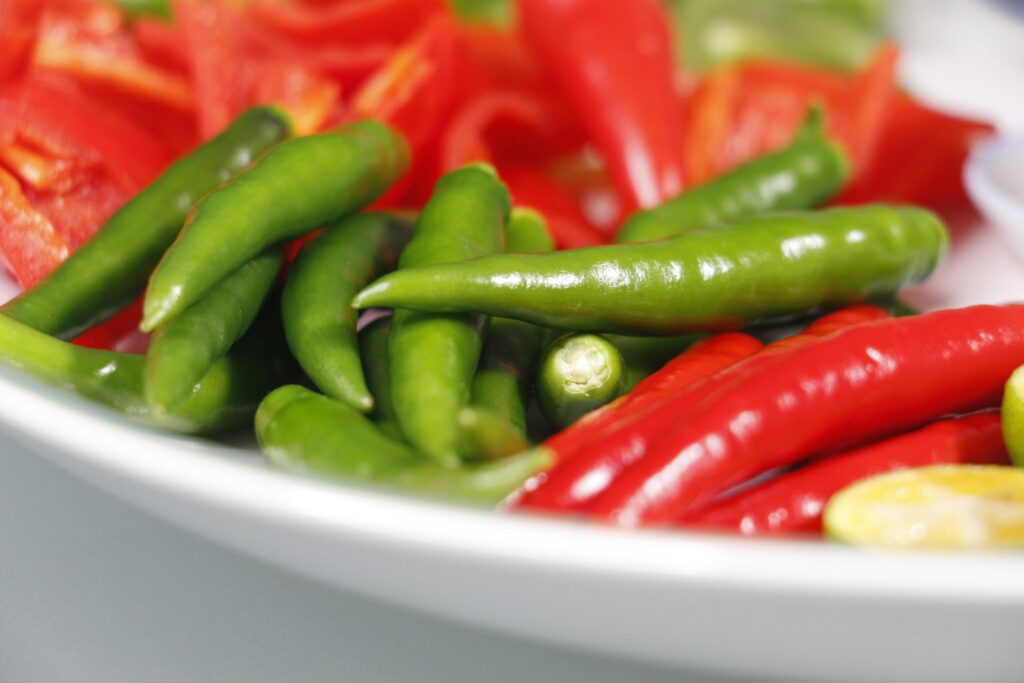
Chili peppers contain capsaicin, the chemical responsible for the burning sensation we feel when consuming them. But here’s the twist: your skin isn’t actually burning. Instead, the capsaicin tricks your brain into thinking there’s heat when in fact there is none. This is a clever defense mechanism developed by chili plants to ward off mammals. Interestingly, birds are immune to capsaicin and are encouraged to eat the peppers, helping the plants spread their seeds.
Rhubarb
Rhubarb is not just a fruit or vegetable; it’s a plant that plays a musical tune as it grows. When grown in the dark in a process known as forced rhubarb cultivation, it grows at an accelerated rate and emits a squeaking, popping sound as it emerges. This noise is produced by the plant rubbing against other stalks as it grows. This is an age-old farming method dating back to the 1800s, aimed at producing tender rhubarb that lacks the stringy texture of sun-grown varieties.
Cashews

You might be surprised to learn that the nut we all know as the cashew doesn’t actually grow on the tree in the traditional sense. Instead, it is attached to the bottom of a cashew apple, a fleshy fruit native to tropical climates. The apple itself is used in some regions for juice, but the nut, which grows separately from the fruit, is the edible part we consume. This unusual growth process makes the cashew one of the more unique nuts in the world.
Cornstarch
When cornstarch is mixed with water, it creates a non-Newtonian fluid, a substance that behaves like a liquid under normal conditions but turns solid when force is applied. This phenomenon occurs due to the molecular structure of starch, which causes particles to interact and form temporary bonds under pressure. When you punch or press the mixture, it becomes solid, but when you relax, it flows freely. This oddity has made cornstarch mixtures a popular subject for scientific demonstrations.
Conclusion
Everyday foods hide incredible natural phenomena that are often overlooked. From the way Brazil nuts refuse to move, to the hallucinogenic qualities of nutmeg, these food phenomena remind us that nature’s science is everywhere, even in the most common ingredients. Next time you snack on pistachios or savor a bowl of corn, remember you’re not just eating food, you’re experiencing the fascinating complexity of nature at work.