We usually encounter spiders out of fear, not wonder. Popular culture has spent decades turning them into shorthand for danger, darkness, and the sudden shock of seeing eight legs move faster than we expect.
Yet that familiar image leaves out one of the most fascinating truths in the animal world: some spiders are not merely interesting, they are genuinely beautiful, decorated with metallic blues, jeweled silvers, flame oranges, velvety reds, and patterns so ornate they look designed rather than evolved.
When we look closely, the spider world starts to feel less like a horror set and more like a hidden gallery. Beauty shows up in unexpected ways, in iridescent body scales, mirrored abdomens, flower-like camouflage, and courtship displays that rival birds in flair and confidence. These remarkable species prove that spiders are not only master hunters and skilled survivors, they are also among the most visually stunning small creatures on Earth.
Sparkle muffin Peacock Spider
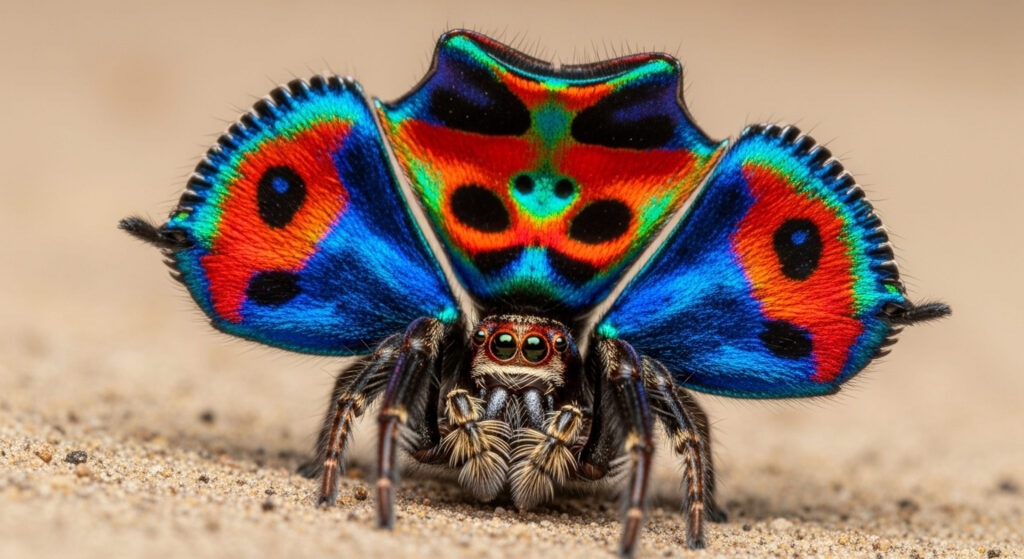
We begin with one of the most unforgettable spiders ever nicknamed, the Sparklemuffin peacock spider. This tiny Australian species is famous for the male’s dazzling courtship performance, which combines raised abdominal flaps, rhythmic leg movements, and a vivid splash of red and blue that looks almost unreal at such a small scale. Its size makes the display even more astonishing, because a creature small enough to sit on a fingernail somehow manages to command attention like a stage performer under bright lights.
What makes this spider so striking is the complete contrast between its scale and its confidence. We are looking at a very small jumping spider, yet the male behaves as if it knows it cannot be ignored. The iridescent abdominal fan, the lifted legs, and the stop-start choreography all work together to create one of the most theatrical mating displays in the arachnid world. Beauty here is not passive; it is performance, motion, and nerve-packed into a body barely larger than a grain of rice.
Brazilian Crab Spider
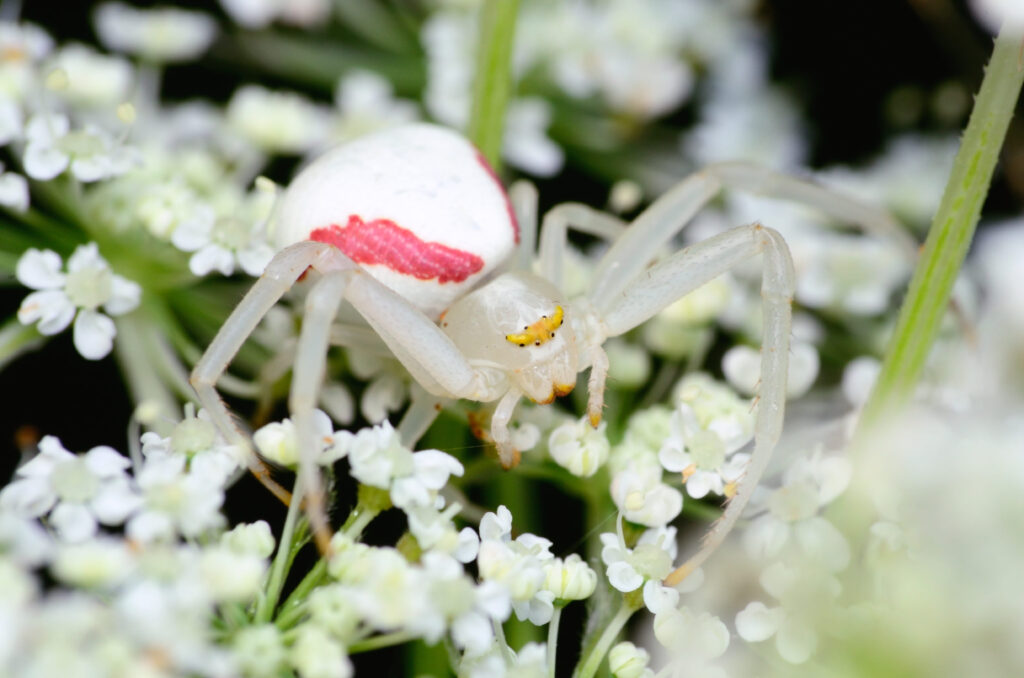
The Brazilian crab spider shows us a different kind of beauty, one built on deception rather than display. Instead of flashing bright colors to attract attention, it uses color and shape to vanish into flowers so completely that it can appear less like an animal and more like part of the bloom itself. Juveniles often match the petals beneath them, and their bodies can carry protrusions and contours that make them look like torn flower edges or unopened petals.
That floral illusion is what gives this spider its eerie elegance. We are not seeing beauty in the usual sense of symmetry and shine alone; we are seeing the beauty of perfect adaptation. Its sideways posture, outstretched front legs, and stillness make it resemble a decorative element until an insect comes too close. In that moment, the illusion breaks, and we are reminded that some of the most beautiful spiders are also the most efficient ambush hunters.
Gooty Sapphire Ornamental Tarantula
Few spiders make a first impression as powerful as the Gooty sapphire ornamental tarantula. Its body glows with deep, metallic blue that can shift with the light, often broken by pale markings and darker geometric bands that give it a polished, almost enamel-like finish.
Many tarantulas are impressive because of their size, but this species adds a level of visual drama that makes it look more like a rare gemstone than a forest predator.
Its beauty becomes even more remarkable when we consider how unusual blue is in the animal world at this intensity. The spider’s vivid coloration gives it a luxurious, almost impossible appearance, especially when the legs are spread, and the body pattern is fully visible.
Yet the elegance comes with force, speed, and a strong defensive reputation, which creates a compelling contrast. We are seeing one of nature’s clearest examples of how beauty and danger can coexist within the same body without weakening either.
Mirror Spider
The mirror spider is one of the strangest and most captivating arachnids we can place on any beauty list. Its abdomen appears covered with tiny reflective plates that catch the light like sequins or polished chrome.
At the right angle, it seems less like a living creature and more like a bead of liquid silver suspended in a web. That reflective effect gives it a surreal quality, as though it belongs in a jewelry case rather than in rainforest vegetation.
What makes it even more mesmerizing is the way its appearance can change. The mirrored patches can seem bright and bold in one moment, then subdued in another, allowing the spider to shift visually with its surroundings. This gives the animal an almost magical presence, one that fits wet leaves, filtered sunlight, and sparkling rainforest air perfectly. We do not just admire this spider because it shines; we admire it because it turns camouflage into art.
Elegant Golden Jumping Spider
The elegant golden jumping spider lives up to its name with ease. Its body carries a warm, metallic richness that can appear gold, coppery, or jewel-toned, depending on the light and angle.
Slender legs, bright highlights, and a polished look give it a refined beauty that feels unusually delicate for a hunting spider. Rather than relying on a single dramatic structure, it draws attention through overall finish, proportion, and sheen.
Jumping spiders are already known for their alert posture and expressive appearance, and this species takes those qualities to almost ornamental levels. We see a spider that seems dressed rather than merely colored, as if every surface has been buffed for effect.
Because it is so tiny, we have to imagine its brilliance at close range, where details that vanish to the naked eye suddenly become extraordinary. It reminds us that some of the world’s finest natural designs are hidden in miniature.
Eight Spotted Crab Spider
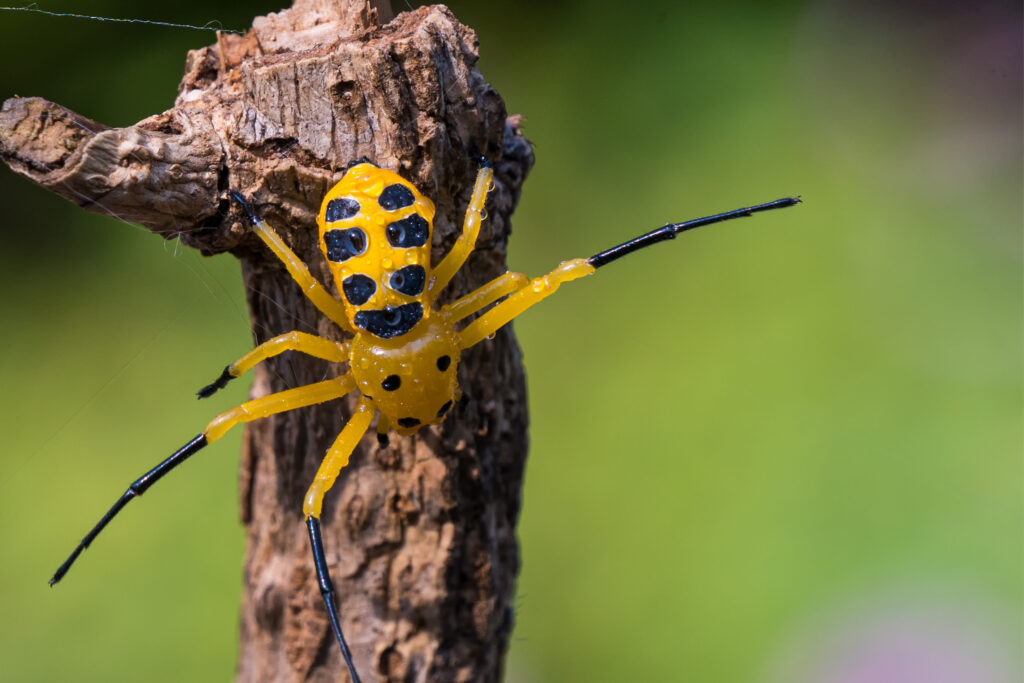
The eight-spotted crab spider stands out because it looks designed around contrast. Its pale body is marked with dark spots that create a bold, graphic pattern, giving it the appearance of a carefully painted ornament rather than a wild hunter.
In a group already known for its unusual posture and flower-ambush tactics, this species adds visual clarity and structure, making it unforgettable. The arrangement of markings gives it a decorative quality that immediately separates it from more muted spiders.
Its beauty also grows with a closer look at shape and stance. The broad body, forward-reaching front legs, and still ambush posture give it an almost sculptural presence. This is not a glittering or furry spider; it is beautiful because its design feels clean, deliberate, and sharply defined. We are drawn to it for the same reason we admire strong graphic art: the pattern is confident, easy to read, and difficult to forget.
Triangular Spider
The triangular spider offers a beauty that feels architectural. Its abdomen forms a compact, angled shape that immediately sets it apart from the more rounded silhouettes many people expect from spiders.
In some individuals, the body can glow with orange, red, yellow, or pale cream tones, turning that unusual geometry into something even more visually striking. The result is a spider that looks crisp, tidy, and oddly stylized, as though sketched with a ruler.
We admire this species because it proves that beauty is not always about brightness alone. Shape can be just as arresting as color, especially when the form is rare enough to surprise us at a glance. The triangular spider seems to carry design principles that belong in modern art, clean angles, controlled proportions, and a compact frame that feels intentional from every viewpoint. It is the kind of spider that changes the mood of a whole branch simply by sitting still.
Long-Horned Orb Weaver
The long-horned orb weaver is proof that strange can be beautiful when structure and color come together well. The female’s abdomen carries long outward spines that give her a dramatic outline, unlike almost any common spider shape.
Those extended horns make the spider look armored, ceremonial, and slightly mythical, as if it belongs to a forgotten emblem rather than a garden or forest edge. Even before we notice the colors, the silhouette alone is enough to stop us.
Then the colors do the rest. Depending on the individual, the body can exhibit vivid combinations of white, black, yellow, or reddish tones, making the horns even more noticeable. We are looking at a spider that treats outline as decoration and bold contrast as emphasis. It turns the web into a stage simply by occupying the center with confidence. Few spiders show so clearly that beauty can come from exaggeration, especially when that exaggeration is balanced by symmetry.
Maratus madelineae
We finish with another peacock spider, because this group represents some of the most extraordinary beauty in the arachnid world. Maratus madelineae belongs to the same broader visual tradition of brilliant abdominal color, confident display, and a level of theatrical courtship that feels almost impossible in an animal so small. Males present richly colored body patterns during mating displays, lifting and positioning the abdomen to turn the body into a visual signal that is both striking and precise.
What makes this spider worthy of the top spot is how completely it captures the central truth of beautiful spiders. It is not just colorful. It is expressive, deliberate, and visually unforgettable in motion and at rest.
Peacock spiders remind us that beauty in nature often evolves under pressure, where survival, attraction, and competition all shape the body into something astonishing. In that sense, Maratus madelineae is more than a beautiful spider; it is a tiny masterpiece of evolutionary showmanship.
Cat Faced Spider
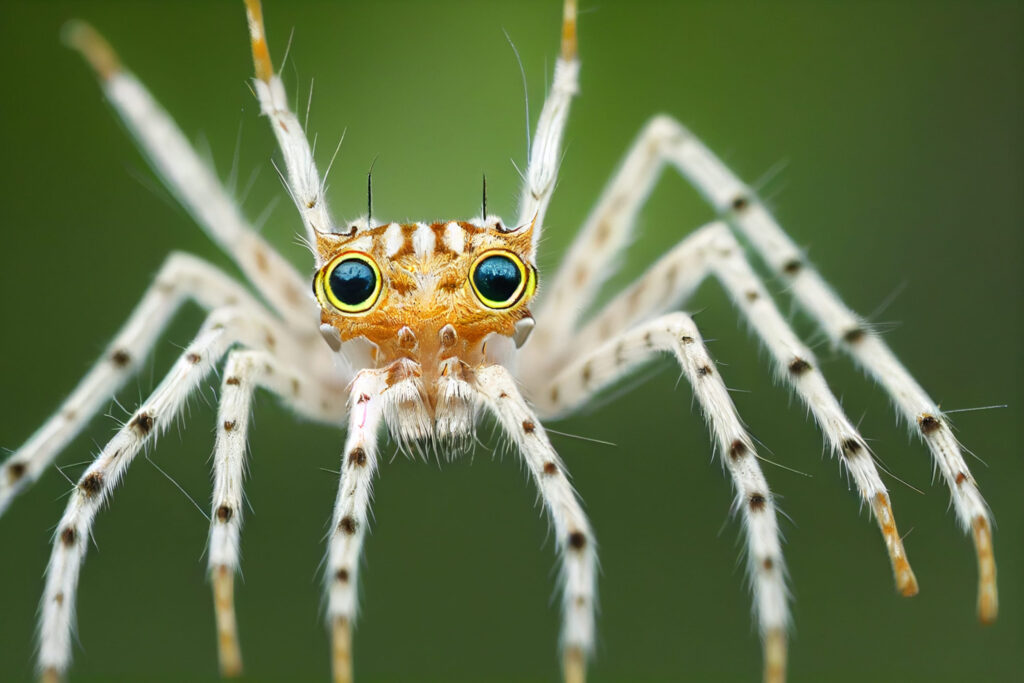
The cat-faced spider has one of the most endearing looks in the arachnid world. Its rounded abdomen rises into two horn-like bumps that create the impression of ears, and its markings can suggest a stylized animal face when viewed from behind.
That illusion gives the spider an oddly approachable charm, especially compared with species that rely on menace or glitter for visual impact. It is a perfect example of how pattern recognition shapes what we find appealing in nature.
Beyond the catlike suggestion, the spider has a soft, textured look that adds to its appeal. Its colors often range through muted creams, tans, grays, and browns, which keeps the overall effect natural and warm rather than flashy. This is a spider that wins us over gradually. We notice the shape first, then the details, then the quiet personality that seems to emerge from the design. It may not be the most vivid spider on this list, but it is certainly one of the most memorable.
Why Beautiful Spiders Matter More Than We Assume
When we focus only on fear, we miss one of the most impressive design stories in the natural world. Beautiful spiders reveal how color, texture, shape, and movement can serve survival without sacrificing visual wonder.
Some use brilliance to communicate, some use camouflage to disappear, and some seem to do both depending on the angle, the light, or the moment. They challenge the lazy idea that spiders are all built from the same unsettling template.
They also force us to look closer, which is often the first step toward respect. Once we notice the mirrored abdomen of one species, the sapphire glow of another, or the flower mimicry of a crab spider, the old stereotypes begin to crack. We stop seeing spiders as a single category and start seeing them as a world of specialists, each with its own logic, style, and ecological role. That shift matters because fascination is often a stronger teacher than fear.