The lobotomy craze sits in medical history like a locked hospital wing nobody wants to reopen. It was sold as a miracle, praised by newspapers, performed in respected hospitals, and even honored with a Nobel Prize. Yet behind the clean white coats and confident medical language was a disturbing reality: thousands of vulnerable people had parts of their brains permanently damaged in the hope that they would become quieter, easier to manage, or less emotionally distressed.
We understand lobotomy today as one of psychiatry’s darkest chapters, but its rise was not random madness. It grew out of overcrowded institutions, desperate families, limited treatments, weak consent standards, and doctors who mistook emotional flattening for recovery. The procedure’s history is not just about one bad idea. It is about what can happen when medical authority moves faster than evidence, ethics, and human dignity.
Doctors Were Working in a Time of Real Desperation
The lobotomy craze becomes more frightening when we understand why so many people accepted it. Before effective antipsychotic medications, many hospitals had few tools for severe mental illness. Patients could face restraints, seclusion, institutional neglect, cold baths, electroshock, and long confinement. Families often watched loved ones disappear into psychiatric hospitals with little chance of returning home.
That context does not excuse lobotomy, but it explains its appeal. NobelPrize.org notes that the prize to Moniz must be viewed against the treatment options available for psychotic patients in the early 20th century, when cruel methods such as straitjackets and cold baths were common before later drug treatments changed psychiatric care.
The cruel irony is that lobotomy looked humane to some doctors because the alternatives were also harsh. That is the nightmare at the center of this history. A bad system can make a dangerous solution look compassionate, especially when desperate people want relief and powerful professionals promise certainty.
The Lobotomy Was Marketed as a Medical Breakthrough
Before lobotomy became a symbol of medical horror, it was introduced as a bold answer to a brutal problem. Psychiatric hospitals in the early 20th century were often overcrowded, underfunded, and filled with patients doctors could barely treat. People with schizophrenia, severe depression, mania, psychosis, and chronic agitation could spend years or decades inside institutions with little hope of improvement. In that environment, a surgical procedure that promised calm looked revolutionary rather than monstrous.
Portuguese neurologist António Egas Moniz introduced prefrontal leucotomy in the mid-1930s. The operation targeted connections between the prefrontal region of the brain and other brain areas, based on the belief that cutting those pathways could reduce severe psychiatric symptoms. NobelPrize.org describes the procedure as an incision into the prefrontal lobe intended to reduce serious symptoms of mental illness, and notes that it became widespread during the 1940s and 1950s before its serious personality effects became impossible to ignore.
The tragedy is that early medical enthusiasm confused manageability with healing. A patient who became quieter after brain surgery could be called “improved,” even if they lost initiative, emotional depth, judgment, or independence. That dangerous definition of success helped the lobotomy craze spread from a narrow experimental treatment into a medical movement.
A Nobel Prize Gave Lobotomy Dangerous Credibility
The most shocking fact about lobotomy is not that it existed. The most shocking fact is that it was rewarded at the highest level of medicine. In 1949, Moniz received the Nobel Prize in Physiology or Medicine for “his discovery of the therapeutic value of leucotomy in certain psychoses.” That official recognition gave the operation a level of respectability that families, hospitals, and doctors could point to when defending its use.
The Nobel committee’s own historical article explains that Moniz introduced prefrontal leukotomy in 1936, that it later became known as lobotomy, and that the procedure destroyed connections between the prefrontal region and other parts of the brain. It also states that roughly 10,000 operations had been performed in the United States by August 1949, before the number began to decline as later treatments emerged.
That Nobel Prize still stands, which makes it one of the most controversial awards in medical history. The decision shows how prestige can freeze a bad idea in place. Once a risky procedure receives elite validation, criticism becomes harder to mount, families become more trusting, and doctors can hide uncertainty behind authority.
The Numbers Were Staggering
Lobotomy was not a rare mistake hidden in a few obscure hospitals. It became a mass medical practice. Verywell Mind, citing historical medical sources, reports that about 50,000 people in the United States received lobotomies, many between 1949 and 1952. It also states that Freeman himself is associated with about 3,500 patients, including children.
Britannica gives a similarly grim picture of Freeman’s career, stating that he performed or supervised more than 3,500 lobotomies and that an estimated 490 people died as a result of the treatment. That number alone should silence any romantic version of the lobotomy era.
The scale matters because it shows how normalized the procedure became. This was not one rogue doctor operating in the shadows. Lobotomy entered hospitals, medical journals, public conversation, and family decision-making. Its spread reveals how a dangerous treatment can become ordinary when society places too much trust in professionals and too little protection for patients.
Walter Freeman Turned Brain Surgery Into a Traveling Spectacle
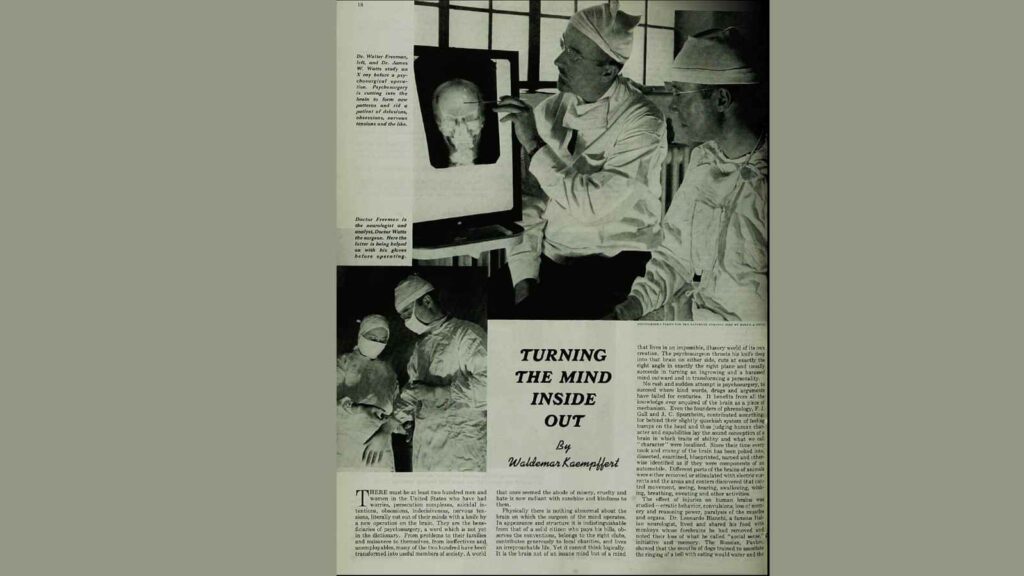
Walter Freeman became the face of lobotomy in the United States, and his role pushed the procedure from controversial surgery into something closer to a medical roadshow. Freeman and neurosurgeon James Watts performed early American prefrontal lobotomies, but Freeman later moved toward a faster transorbital method. This version entered through the eye socket, avoiding the more formal skull-drilling approach of earlier procedures.
Britannica reports that Freeman began refining transorbital lobotomy by 1945 because he believed it was faster, cheaper, and more effective than standard lobotomy. His instrument was initially an ice pick, and later a specially designed tool, which he used to destroy neural tracts he believed were linked to mental illness.
Freeman’s confidence became part of the danger. He courted media attention, toured hospitals, and performed operations in settings that should have terrified anyone paying close attention. Britannica notes that James Watts broke with Freeman after objecting to the procedure being done outside proper surgical settings, including private offices and other nontraditional locations.
“Improvement” Often Meant Losing the Self
The central deception of the lobotomy era was the meaning of improvement. Many patients became less agitated after surgery, but calmness did not always mean recovery. A person could become passive because the procedure damaged their emotional range, motivation, planning, or personality. For institutions struggling with overcrowding, a docile patient could look like a successful patient.
Britannica states that intended effects included reduced tension or agitation, yet many patients also developed apathy, passivity, poor concentration, lack of initiative, and reduced emotional depth. Some died as a result of the procedure.
This is where the lobotomy craze becomes morally devastating. The procedure often treated the burden placed on hospitals and families, not the full humanity of the person receiving it. A patient who stopped resisting, stopped crying, stopped raging, or stopped demanding attention could be labeled better, even when the operation had stolen something essential.
Children and Vulnerable Patients Were Not Spared
One of the darkest parts of the lobotomy craze is how easily vulnerable people could be placed under the knife. Children, women, institutionalized patients, and people with limited ability to refuse were especially exposed. Consent standards were weak, and families could authorize life-altering surgery for reasons that mixed fear, shame, exhaustion, and social control.
Howard Dully’s story remains one of the most disturbing examples. StoryCorps describes “My Lobotomy” as Dully’s personal journey to uncover the truth about receiving a lobotomy at age 12. The producers reviewed medical records and found that Freeman had been diagnosed with schizophrenia, but independent analysis of those records indicated the diagnosis was unfounded and incorrect.
Dully’s case exposes how elastic psychiatric labels could become when a doctor already believed in the procedure. A difficult child, a grieving family, a fearful stepmother, and a confident physician became a disastrous combination. The result was not treatment. It was childhood permanently interrupted by a surgical experiment.
The “Ice Pick” Lobotomy Was Fast, Crude, and Terrifying

The transorbital lobotomy became infamous because it made brain surgery look almost casual. Instead of drilling into the skull, the doctor accessed the frontal lobes through the eye socket. Freeman’s method could take less than 10 minutes and left little visible scarring beyond bruising around the eyes. That speed helped spread the procedure, but it also revealed how recklessly simple the operation had become.
StoryCorps explains that a prefrontal lobotomy involved drilling holes in the skull, while a transorbital lobotomy reached the brain through the eye sockets. Its summary also notes that the transorbital version could take less than 10 minutes and could be performed outside an operating room.
The speed was not a virtue. It was a warning sign. A procedure that permanently alters a person’s brain could be completed faster than many routine medical appointments. The human cost was hidden behind the language of efficiency, and the patient’s future was gambled on a few violent minutes.